Quinze Tablas
Sympkyn of the Moor
Number of players: 2
Type of game: Dice / Tables
Period: 13th Century
Quinze Tablas (“Fifteen Pieces”) is the first of the tables games described in King Alfonso X of Castile’s Libro de los Juegos. Like the other tables games it is an ancestor of backgammon, played on the same 24 point board with 15 men each, but it uses three dice and has one very distinctive rule: no point may ever hold more than two men. This makes it a game of blocking and capture as much as a race.
History of Quinze Tablas
Origins: The game is described on folio 73 of the Libro de los Juegos (“Book of Games”), completed in Alfonso X’s scriptorium in Toledo in 1283. It is the first of the fifteen tables games in the book, alongside games such as Emperador, Todas Tablas and Fallas (the Spanish form of Fayles).
Name: Quinze tablas simply means “fifteen pieces”, after the fifteen men each player uses.
Base Seven Version: Alfonso, who was fond of the number seven, also describes a version played on a board of seven points per quarter with seven sided dice. Quinze Tablas is the ordinary six point version of the same game.
Interpretation: Alfonso’s text is not easy to follow and scholars read it differently. Sonja Musser suggests a simple race where the two sides never cross, while H.J.R. Murray and David Parlett read it as a game of contrary motion, where the players move in opposite directions and pass through each other. The rules below follow the contrary motion reading.
Traditional Rules of Quinze Tablas
Setup
Board: A standard tables board of 24 points in four quarters of six points each.
Pieces: Each player has 15 men.
Dice: Three six-sided dice.
Starting Position: Each player places two men on each of the six points of their starting quarter (12 men), and their last three men in the outer table immediately next to it, two on the first point and one on the second.
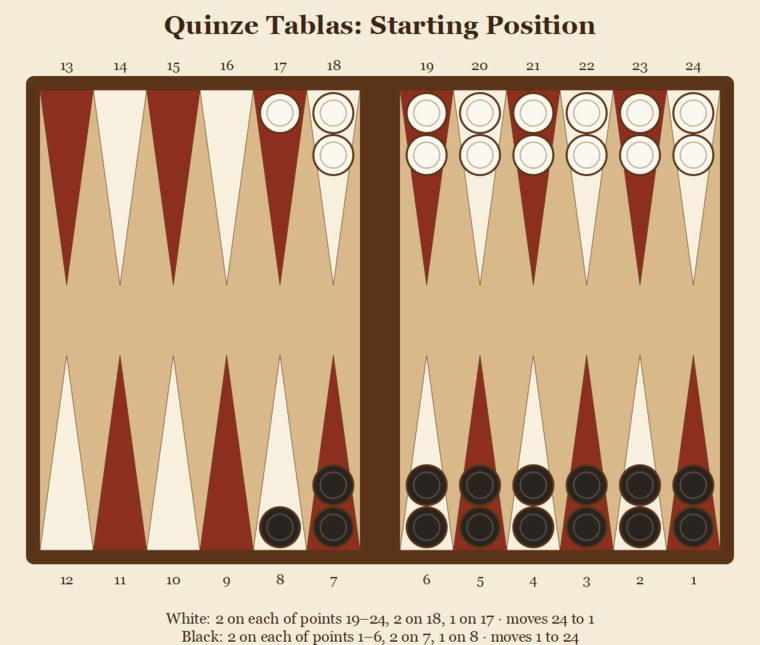
Quinze Tablas Starting Position
Objective
- Move your men around the board, in the opposite direction to your opponent, to take up the mirror of your starting position in your opponent’s starting quarter.
Gameplay
Players take turns throwing all three dice.
Each die moves one man the number of points shown. The same man may be moved by more than one die. Doubles and triples earn no bonus moves.
No point may ever hold more than two men. Two men on a point block it to the opponent, but you can also be blocked by your own men.
A single man left alone on a point can be hit by an opponent landing on it, and is taken off the board.
A hit man is re-entered by placing it on any empty point, or a point holding one of your own men, in your starting quarter. No dice throw is needed to re-enter.
A die that cannot be played is lost.
Victory Conditions
The first player to bring all their men around into the finishing position wins.
A player also wins if their opponent has men waiting to re-enter and cannot place them because every point in their starting quarter is full.
If neither player can move whatever the dice show, the last player to have moved wins.
Optional and House Rules
1. Race Version
- Play Sonja Musser’s reading as a simple race: both players move their men into their own inner table and then bear them off, with the first to bear off all 15 winning.
2. Bearing Off
- Instead of finishing in the mirror position, allow men to be borne off once they reach the opponent’s starting quarter, as in Tables.
3. Seven Point Board
- For something closer to Alfonso’s heart, play on a board with seven points per quarter using seven sided dice.
Summary Table
| Phase | Action |
|---|---|
| Setup | Two men on each point of your starting quarter, two on the next point of your outer table and one on the point after. Three dice. |
| Movement | Each die moves one man. No more than two men on any point. Lone men can be hit and are re-entered in your starting quarter. |
| Victory | Reach the mirror of your starting position first, or leave your opponent unable to re-enter or move. |