Put and Take
Sympkyn of the Moor
Number of players: 2+
Type of game: Dice / Teetotum
Period: 16th Century
Put and Take is a simple gambling game played with a teetotum, a small spinning top with four flat sides that is used in place of a die. Each side is marked with a letter telling the spinner what to do: take from the pot, put into it, do nothing, or take the whole pot. It needs no skill at all, which made it popular with children and gamblers alike.
History of Put and Take
The Teetotum: Spinning tops marked in place of dice go back to the Greeks and Romans. The four sided teetotum was a common gambling toy in mediaeval and Tudor Europe.
Name: The name teetotum comes from the T side, which stood for Latin totum, “all”. The top was first called a totum, and later a “T-totum”.
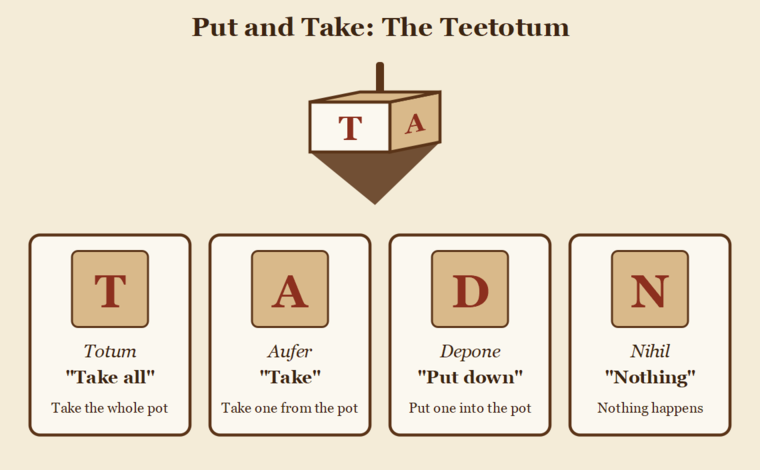
The Letters: The earliest tops were marked with four Latin letters: A for aufer (“take”), D for depone (“put down”), N for nihil (“nothing”) and T for totum (“all”).
Popularity: Put and Take was a popular gambling game from the 16th century. By the 17th century the top was often replaced by a four sided long die called a Long Lawrence, rolled along the table rather than spun.
Later Forms: In the 18th century Joseph Strutt recalled English tops marked T (take all), H (half), N (nothing) and P (put down). The Jewish dreidel is a close relative of the same top.
Traditional Rules of Put and Take
Setup
Teetotum: A four sided top marked T, A, D and N.
Stakes: Each player needs a supply of coins, tokens or sweets.
The Pot: Every player puts one stake into the middle to start the pot.
The Put and Take Teetotum
Objective
- Win as many stakes as possible from the pot, or be the last player left with stakes to play.
Gameplay
Players take turns to spin the teetotum.
When it falls, the letter on the upper side tells the spinner what to do:
T (Totum): Take the whole pot.
A (Aufer): Take one stake from the pot.
D (Depone): Put one stake into the pot.
N (Nihil): Nothing happens.
Whenever the pot is empty, every player puts in one stake to start it again.
A player who cannot pay when they have to is out of the game.
Victory Conditions
- The game ends when only one player has any stakes left, or at an agreed time or number of rounds, when the player with the most stakes wins.
Optional and House Rules
1. Strutt’s Letters
- Use the later English markings: T take all, H take half the pot, N nothing, P put down one.
2. Long Lawrence
- Instead of a top, roll a four sided long die with the same four markings along the table.
3. Six Sided Teetotum
- Use a six sided top and add two more faces, such as Put Two and Take Two, for bigger swings.
4. Everyone Pays
- A D means every player except the spinner puts one stake into the pot.
Summary Table
| Phase | Action |
|---|---|
| Setup | Each player puts one stake into the pot. |
| Spinning | T take the whole pot, A take one, D put one in, N nothing. Refill the pot when it is empty. |
| Victory | Last player with stakes, or most stakes when play ends. |