Fayles
Sympkyn of the Moor
Number of players: 2
Type of game: Dice / Tables
Period: 14th Century
Fayles is one of the family of mediaeval tables games, the ancestors of modern backgammon. It is played on the standard tables board with 15 men each, but uses three dice rather than two. Its name comes from its most distinctive rule: a player who throws a number they cannot play fails, and loses the game.
History of Fayles
Origins: Fayles is recorded in an English manuscript of around 1300, which describes a number of tables games played in England at the time. An early version of the rules is recorded in Alfonso X’s Libro de los Juegos.
Name: The name is thought to come from Old French faille, “failure”, after the rule that a player who cannot move loses.
Family: It belongs to the wider group of tables games, alongside Tables itself, that were played across mediaeval Europe before backgammon took its modern form.
Modern Study: Most modern reconstructions draw on H.J.R. Murray’s A History of Board Games other than Chess (1952), which translates and discusses the mediaeval tables manuscripts.
Traditional Rules of Fayles
Setup
Board: A standard tables board of 24 points in four quarters of six points each.
Pieces: Each player has 15 men.
Dice: Three six-sided dice.
Starting Position: Each player places 13 men on their own six point and 2 men on their opponent’s one point. The men are moved around the board towards the player’s home quarter.
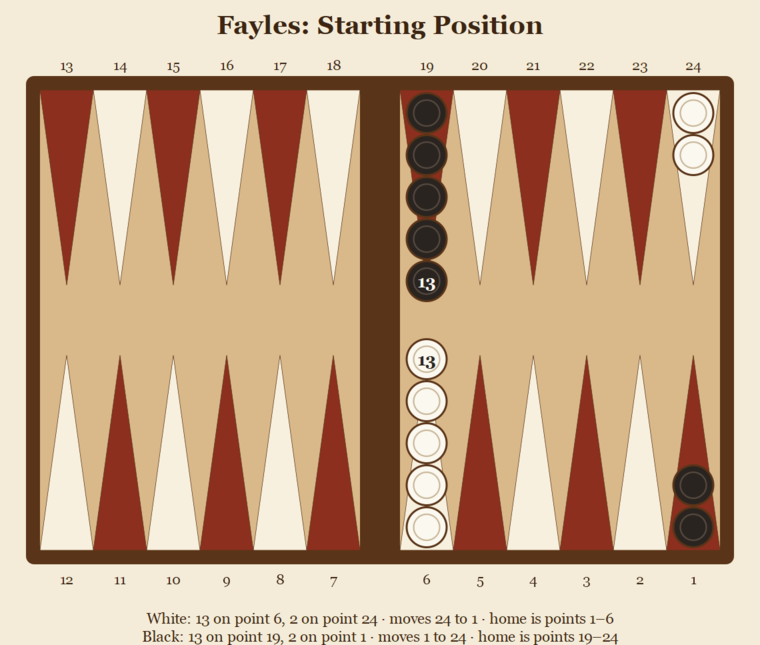
Fayles Starting Position
Objective
- Move all 15 of your men around the board into your home quarter and bear them off before your opponent does, without failing along the way.
Gameplay
Players take turns throwing all three dice.
Each die is played separately. Any man may move by the number shown on each die, or one man may use two or more of the dice in turn.
A man may not land on a point held by two or more enemy men.
A single man left alone on a point can be hit and sent back to start again. If the first point is blocked you may not hit a man.
The Fail: If a player throws a number they cannot play because every possible move is blocked, they fail and lose the game at once.
Victory Conditions
The first player to bear off all 15 men wins.
A player also wins straight away if their opponent fails by being unable to play a throw.
Optional and House Rules
1. Two Dice Play
- For a gentler game, play with two dice instead of three. The fail rule becomes less likely to end the game early.
2. Soft Fail
- For beginners, a player who cannot play their throw simply loses their turn instead of the whole game.
3. Match Play
- Play a set number of games, or first to a set score, so one unlucky fail does not decide the whole contest.
Summary Table
| Phase | Action |
|---|---|
| Setup | 15 men each on a 24 point tables board, three dice. |
| Movement | Throw three dice and play each die separately. Blocked points (two or more enemy men) cannot be landed on. Lone men can be hit. |
| Fail | A player who cannot play their throw fails and loses. |
| Victory | Bear off all 15 men first, or win when your opponent fails. |